
Western Solace: Valley James Finds Herself in Song
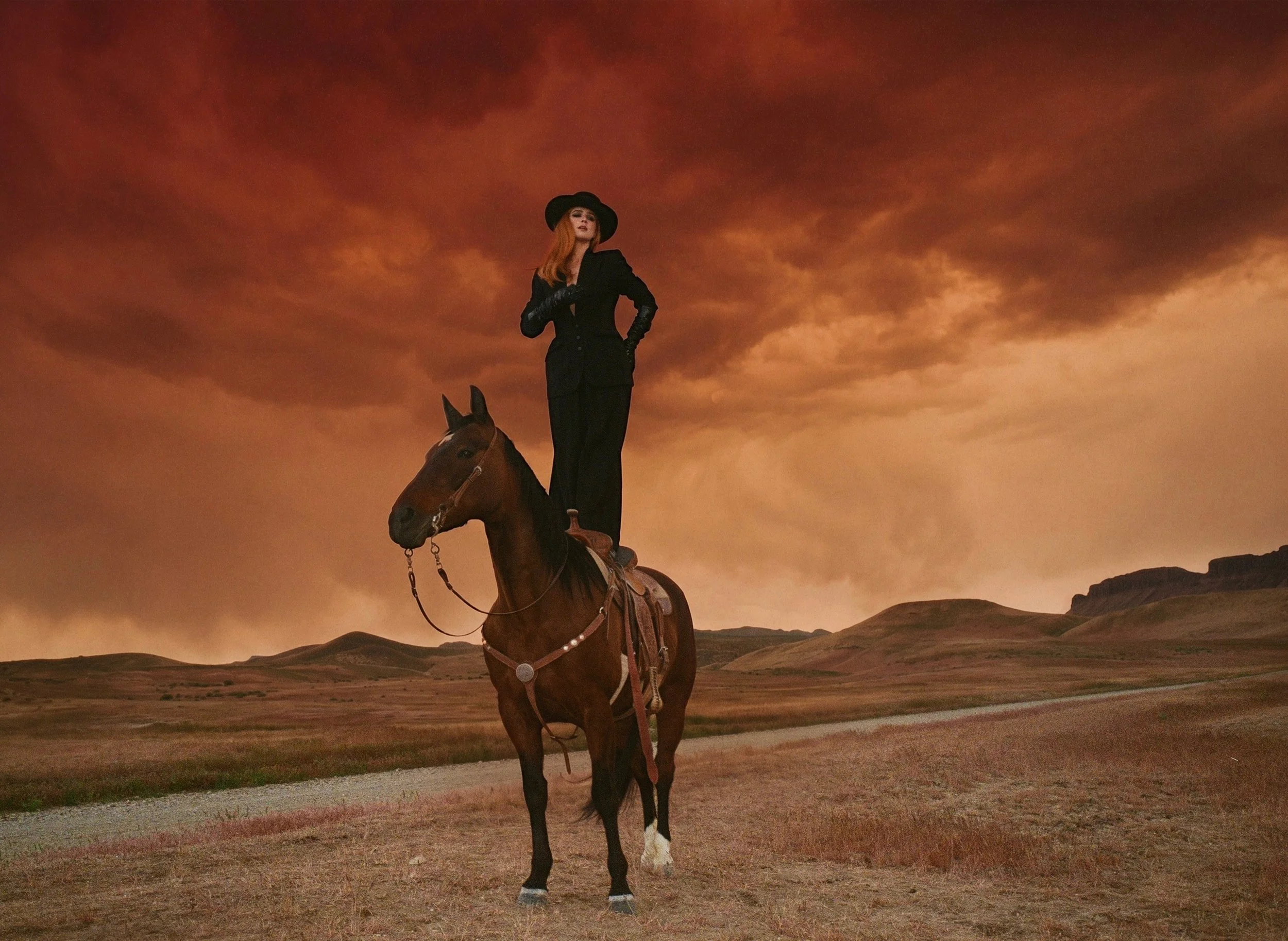
Photo by: Alexa King Stone
Written by: Anna LoPinto
An 8-year-old Valley James trots confidently on her sleek black gelding, Obsidian, riding through the sagebrush and cheatgrass-covered foothills of the Snake River Valley in Star, Idaho. Dust settles onto her saddle as she moves across the arid earth, keeping a keen eye out for a coiled rattler or a clever coyote — resilient creatures of the desert, survivalists with whom she shares much in common.
The daughter of a long lineage of troubled and violent souls, the land became James’ refuge, and crossing it, her ritual. With the rhythmic footfalls of her horse, James begins to exhale; her jaw softens, her shoulders lower. Though surrounded by desert, James sees the verdant Boise River to the south and the pine-covered Rocky Mountains to the north. She inhabits the world of the in-between, and here she finds peace.
“The West, to me, is a really accurate representation of liminal space. In the desert, you can see for miles, but you don’t necessarily know what’s ahead. It’s overwhelmingly beautiful, but also terrifying when you’re walking through it.”
“I used the landscape I grew up in as an escape,” the Nashville-based singer/songwriter says. “The West, to me, is a really accurate representation of liminal space. In the desert, you can see for miles, but you don’t necessarily know what’s ahead. It’s overwhelmingly beautiful, but also terrifying when you’re walking through it.”
Defined by thresholds, transition, and uneasy familiarity, liminal spaces can feel both unsettling and cathartic. So too does James’ music, with its tension-filled twilight sound that boldly faces despair and hope in equal measure. “Liminal space as a concept — that’s a huge part of my artistry because I’ve lived in it,” she says. “It’s a tumultuous and beautiful place to exist.”
Raised by a cowboy and a singer who met at a barn dance, James’ childhood felt steeped in the mythology of the American West. She barrel raced through her teens and by 17, was living in Asia and Italy working as a model. She married her high school sweetheart at 22 and divorced by 23. After a brief stint in New York City, James returned to Idaho to study historical fashion at Boise State, developing the visual language that would later shape her music
Photo by: Mike Vanata | Western AF
There is restraint to the way James tells her story – a strong and necessary wall. Poised pauses punctuate her thoughts as she arranges them carefully, but the pain remains palpable. “My childhood was like anybody else’s who has generational trauma to unravel. The land protected me while my family life was coming apart,” she says. Her songwriting, however, is where she finds the strength to explain herself. “First time I thought of dying I was seven years old,” she sings on “Playing Dead,” off her debut album, Star, continuing: “My mother’s hands pressed against my mouth / Her rage was silent, no one ever knew / We were living in a burning house.”
James’ voice is ethereal, commanding, and emotive. Deliberate yet delicate, she kept it hidden for decades. “Once my sense of self started forming, singing became something shameful,” she says. “My ancestors wanted to become singers, but it became a point of pain, and my experience was that it was not to be toyed with or looked at.” She consumed music quietly and privately: ’90s country, Townes Van Zandt, Gillian Welch, Patsy Cline, Roy Orbison, Deftones, Rage Against the Machine, and System of a Down. “I was obsessed with singing, but nobody knew. Nobody.”
Post-divorce, James found herself at a crossroads, unable to see far into the distance. Modeling had brought success, but only deepened her feelings of unworthiness. After finishing her degree at Boise State, James plunged into the unknown: pawning her wedding ring for a black Fender Telecaster and relocating to Los Angeles: “I decided I was going to do music.”
Photo by: Megan Mae
Amid the upheaval, unexpected hope appeared. “My pain came from people, but my recovery also came through people,” she says. “There are little bits of grace everywhere — in community, land, animals, and music.” In 2016, James attended a writing camp hosted by Steve Earle, where friends secretly signed her up for a writers’ round. Apprehensively, she agreed. She sang and loved it. “Steve Earle came to me the next day and said, ‘Hey, you’re good. You should keep going,’” she says. “And I did.”
Back in California, while working at a denim store, James asked the universe for a sign. The next day, an older gentleman walked into the shop, heard her picking on a Martin guitar, and asked her to sing. When she finished, he told her she should move to Nashville. The man was Bruce Johnston of The Beach Boys.
A month later, in January of 2017, James relocated to Nashville, where the city’s songwriting culture and deep-rooted country music sensibility resonated with her. “I loved the structure of country songwriting while incorporating the metaphors and visuals of my western home.” For the first time, James could fully be herself. All of her artistic instincts finally had somewhere to converge: the starkness of the desert, vintage fashion, grief, sensuality, and the spaciousness of the West. The result was something shadowy and genre-blurring, hovering somewhere between alternative country, goth folk, and cinematic western.
James’ debut album, 2025’s Star, feels like a world entirely her own — haunting, feminine, windswept, and unafraid of darkness. The songs and accompanying visuals explore death, reinvention, desire, and identity. Her work feels inevitable — wholly her own, yet steeped in the feeling of something old and half-forgotten.
James went from hiding her voice to headlining tours and supporting artists like Stephen Wilson Jr., Orville Peck, and The Lone Bellow. By trusting her art, she emerged from liminal space and into a life of her own making.
“You know, you can actually rewrite your story at any time,” she says with a grin.

Western AF is not currently accepting feature pitches for Western Dispatch. If you simply can’t help yourself you can send it to westernafsubmissions@gmail.com but, really, we aren’t accepting pitches.