

Photo by: Acacia Evans
By Garret K. Woodward
There’s a number saved in my smart phone as “Stephen Wilson Dreamy Draw.” Yes, that Stephen Wilson, the one with the “Jr.” at the end of his name. The same Stephen Wilson Jr. that’s erupted onto the Americana, rock, and country music scenes over the last few years, who just won “New Artist of the Year” at the CMA awards and just received his first Grammy nominations for “Best Country Solo Performance” and “Best Country Song,” and who recently soared through a duet with Eddie Vedder of Temple of the Dog’s “Hunger Strike” at the Ohana Fest in California.
Once in a while, I’ll text “Stephen Wilson Dreamy Draw,” usually to congratulate him on whatever well-deserved achievement I just read about. And, by god, he responds, always. When the CMA “Male Vocalist of the Year” nominees included him, I sent my regards. “Thank you, Garret. Pretty wild, man,” he replied. Yeah, my dude. It is pretty wild. The rocket ship ride of Stephen Wilson Jr. is real, and fast.
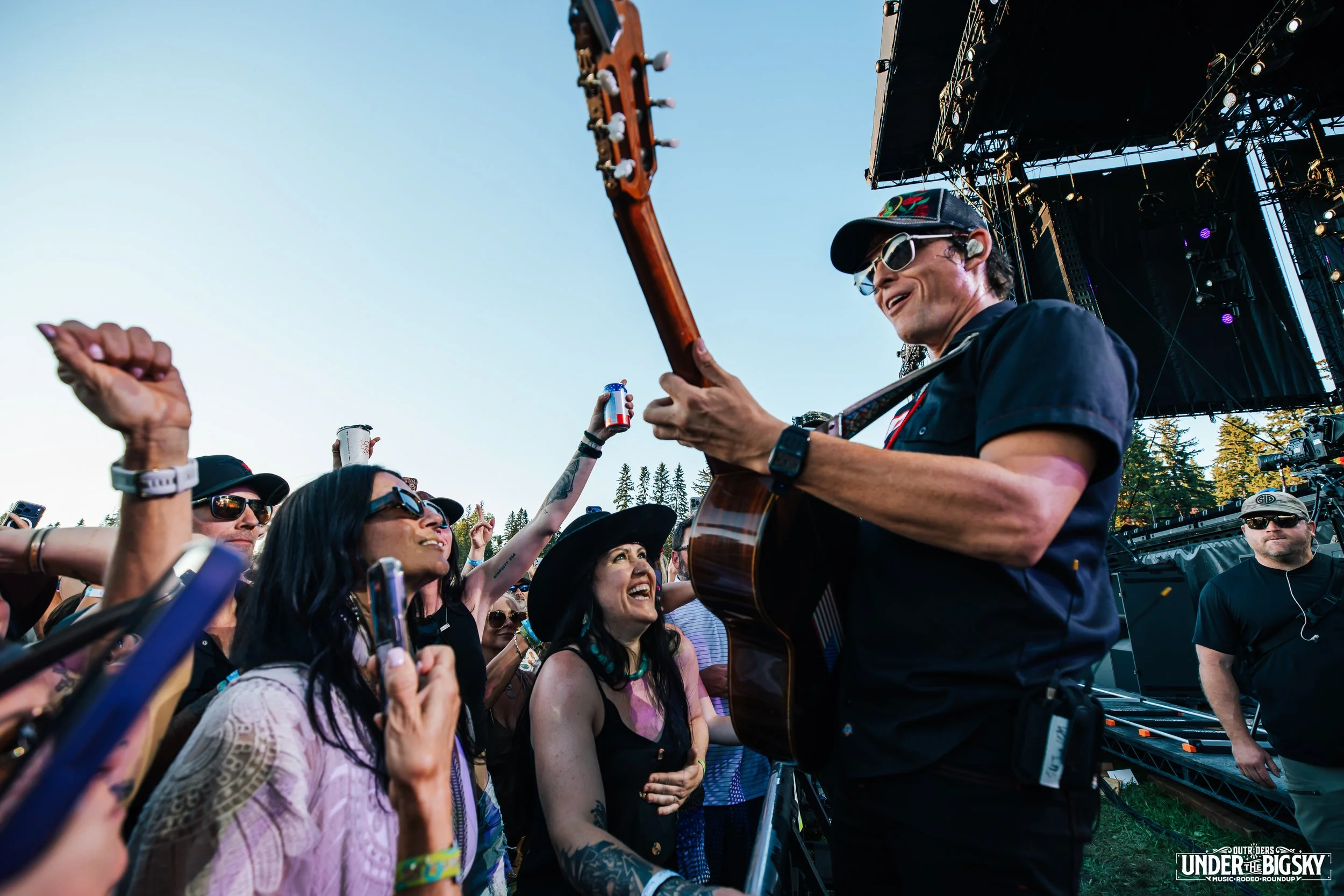
Photo By: Felcia Garcia ( @fixationphotography )
“Honestly, I haven’t looked in the rearview mirror much,” Wilson tells me backstage at the Under the Big Sky festival in Montana this past July. “I don’t know, I’m very much in it, and one day I think I’ll sit back and figure out what the hell just happened. I don’t think now is the proper time to process it all, because it’s all happening at an alarming rate.”
Wilson equates his continued musical journey to his lifelong passion for boxing (he was introduced to the sport at age seven by his father), something he was also very talented at, so much so that he would eventually find himself in the finals of the Indiana State Golden Gloves.
“When you’re boxing in a fight, you’re not thinking about the rounds as you’re fighting, you think about the fight when the fight’s over,” Wilson says. “And you’ll pour over it, and you’ll really kind of figure out what happened in there. But, in the middle of the rounds, you’re just very much in it.”
He would parlay that discipline and passion for boxing into another career path — becoming a scientist and working in research and development in the labs of the Mars corporation. In the background throughout all this was Wilson’s steadfast devotion to playing music, the emphasis being on songwriting, with subjects usually hovering around his troubled childhood and alienation.
“I just try to observe [life] as a scientist and report my findings. Technology is always cannibalizing other technologies, and with AI, our humanity is our best weapon, our best commodity — that’s why live music is so heavily in demand right now,” Wilson says. “AI is not a singular source, and we love singular sources as artists. The source will always be the most important thing because the source is the art, and once people realize that AI is the source, it becomes non-art. People want art because that makes them feel something, because the sources and the product are not separate.”
The first time I encountered Wilson was on assignment in November 2023 at the Dreamy Draw festival in Scottsdale, Arizona. I hadn’t heard of him before, just another artist name on the lineup poster that would hit the stage at some point that weekend. And yet, it’s those kinds of circumstances that offer up the most transcendent of musical experiences, for I wasn’t alone in not knowing who he was — there were a lot of us without a clue at Dreamy Draw.

Photo by: Jace Kartye
“People don’t know what’s real or not, and they’re just trying to make sure they’re seeing something real and leaning into that”
“People don’t know what’s real or not, and they’re just trying to make sure they're seeing something real and leaning into that,” Wilson says. “And I really lean into the feral wildness of our shows. Anything can happen, nothing is planned. Lean into anything unpredictable, anything that is non-algorithmic.”
And I also wasn’t alone in becoming an immediate fan when I happened to walk by his set heading to see another band. Wilson stopped me in my tracks. “Who in the fuck is that?” I said to myself. He was stunning and magnetic, with this stovepipe voice that rumbled through the festival grounds. He was like this heavy anchor dropped into the choppy seas of life that provided stability, solidarity, and a safe haven to exist as yourself, and in your own time.
Following the set, I walked backstage and introduced myself to Wilson. “What is your deal, man? That set was incredible,” I said, shaking his hand. In his “aw shucks” manner and humble tone, Wilson thanked me for the kind words. His demeanor offstage was shy, honest, and completely vulnerable, the ying to Wilson’s onstage yang of fearlessness and bravado. We exchanged phone numbers and made plans to interview at some point soon.
In conversation, Wilson lowers his head and focuses on the ground his feet are firmly planted on. When asked questions, his head slowly bobs up and down like a boxer listening to instructions from a trainer. And Wilson is always listening, this constant absorption of our society swirling surrounding him, for good or ill. He’s also a big follower when it comes to the “power of the now.”
“I have to [believe in ‘the now’]. For any artist in this particular business, time can be a real problem because time isn’t real, it’s just a construct we made up,” Wilson says. “I try not to subscribe to [the idea of time], [but] I believe entropy is real. So, living in the now is trying to live without time. You’re trying not to subscribe to that particular paradigm that you’re running out of time.”
It’s not that the idea of running out of time is a sore subject for Wilson. Far from. If anything, he looks at his trajectory in the music world (and life, in general) as part of that adage of “we all have our victories in our own time.” At 47 years old, Wilson was the oldest nominee for CMA “New Artist of the Year,” which was bookended by 22-year-old Avery Anna (the other three names in the category were all under 30, too).
“That’s one of the biggest enemies of this game — ‘You’re running out of time.’ That voice has to be silenced, you gotta cut it out at the root, ‘cause then you’re gonna waste time worrying about it,” Wilson says. “Or people think they’re ‘too old’ for this. It’s just so ridiculous to think, ‘Oh, I can’t be a professional musician because the Earth went around the sun this many times since I was born.’ That’s a ridiculous thing to quantify your relevance or what kind of contribution artistically you can make to society. So, I try to stay in that [thought process] because, on paper, none of this is supposed to happen — none of this makes sense.”
At Under the Big Sky, Wilson can hear the roar of the crowd at the nearby Great Northern Stage. Thousands of joyous faces rocking out to Ryan Bingham & The Texas Gentlemen. Soon, Wilson will follow Bingham, only to then have Zach Top play after him to close out the night. For Wilson, the festival slot is not only indicative of his rise into the national spotlight, but also how his talents are just as worthy as those bookending his set.
“My dreams out-dreamt me a long time ago,” Wilson says. “And I don’t really know what to expect — [but], I’m game for it.”

Western AF is not currently accepting feature pitches for Western Dispatch. If you simply can’t help yourself you can send it to westernafsubmissions@gmail.com but, really, we aren’t accepting pitches.